
RM & DM MBA COURSE
Master of Business Administration (MBA) | Development Management|Rural Management
School of Management
About the Programs-
Being the fifth largest economy and the second highest populated country, the development story of India has been through many peaks and valleys. According to Forbes magazine the 15 richest Indians has a cumulative worth of USD 215 billion and at the same time 363 million remain Below Poverty Line (BPL). Quoting Mahatma Gandhi’s golden words “India lives in its villages”, 65 percent population live in rural villages, and 85 percent of them primarily depend on agriculture for their livelihood. Data from National Sample Survey Office (NSSO) data shows that more than one-fifth of rural households with self-employment in agriculture have income less than the poverty line, agriculture labour productivity in terms of gross value added (GVA) in India is less than a third of that in China and 1% of that in the US. Further, taking into account other socio economic indicators such as; education, health, housing, amenities and employment, the performance of rural India is abysmal. To address it, there have been several reforms being undertaken since independence by the respective elected governments in terms of policies, public institutions and investment in public infrastructure. In addition to it, several initiatives have been taken at the grass root level by many not for profit agencies as well as the corporates through their social responsibility activities. However a major obstacle lies in manging these organizations by professionals who are competent and also willing to make a career in these sectors. Keeping these challenges in mind the Master program in Development Management (DM) and Rural Management (RM ) was conceived.
Program Structure
The MBA in DM&RM is a two year full time residential program. The objective of the programs is to create a cadre of professionals to promote sustainable and equitable socio-economic development of the people in general and that of underprivileged sections of the society in particular and empower the communities through professionally managed institutions. The focus of the program is management of development and agribusiness sectors within the spirit of justice, liberty, equality, equity, fraternity and environmental sustainability. Most of the organisations of, by and for poor are often undermanaged, mis-managed and working in cross-purpose. The professionals graduating from this program will perform a role of field action managers and through their expertise will strengthen those institutions as well as create new institutions for realising the above objective.
The Learning Approach:
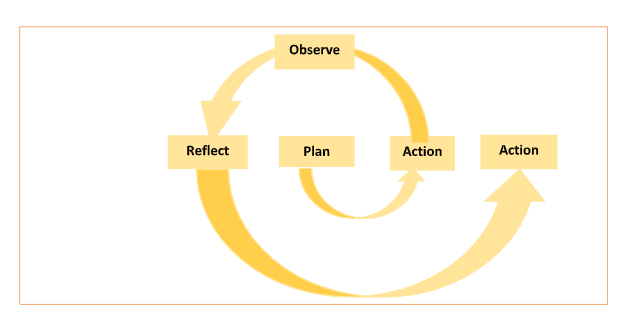
Programme (DM&RM) will be facilitated through a Participatory Learning & Action Approach (PLA). It is a way of learning where the participants learn through a taking a series of predefined actions followed with structured reflection on the tasks and activities thus leading to design a suitable course of action. An Illustration of the PLA is given below.
The Methods:
All the learning methods mentioned below are influenced with the principles of participatory/Experiential action learning
- Rural immersion for students during this field work will be actual working with SHG’s has to stay with villager’s home for understand the realities of the rural areas and developing good relationship with the villagers for implementing social development projects.
- Field Learning is an integral part of the programmes which will enable the participants with action-reflection-action learning and prepare them with their ability to solving problems in real life situations in the rural and urban development context. Each course will be mapped by keeping in mind the design principle of Participatory and experiential Learning where students learn by working in field.
- Method of teaching will be highly creative innovative in nature. The teaching will follow an intuitive method of learning the basic paradigms. Concepts, theories, practices and facts. Besides, the classroom teaching sessions will follow a path of logical sequence of practical knowledge seeking mode. The students will engage in a variety of modes and means of seeking information and transforming them into knowledge sets. Lectures both online and classroom are typically to stimulate discussions based on the inputs from the field or analysing a case and reflect it to the development/management concepts. Besides classroom teaching, there will be workshop, conferences, and online class on various dimensional on rural management and rural development.
- Development internships with partner institutions /organizations to appreciate the real-life situation with an experienced supervisor/ mentor from the organization. The students will be engaging with the five to six SHG’s to understand their needs and issues, during his filed work students will be receiving stipend for work with SHG’s during field work. After completion of course students can be work with the SHG’s as intern for one year to learn more about the rural realities with option to avail the jobs during the placement season.
- Workshops are designed & facilitated by expert practitioners from development and rural sector to provide not only the state of art practices followed by organizations but also appraise the students with the challenges and finding ways to generate a solution.
Course Structure
Course curriculum MBA Development & Rural Management 2020-2022
|
Semester I |
Semester II |
||
|
Name of Subject |
Credits |
Name of Subject |
Credits |
|
Indian Rural Society and Rural Administration |
4 |
Managerial Economics |
4 |
|
NRM and Sustainable Livelihoods Course |
4 |
Financial Accounting |
4 |
|
Concept and Theories of Development |
4 |
Organizational Behaviour |
4 |
|
Indian Economy and Policy |
2 |
Food Security and Right to Food |
4 |
|
Community Organisation and Development |
2 |
Social Research Methods |
4 |
|
Contemporaray Development Communication |
4 |
Climate Change, Sustainability and Organisations |
3 |
|
Gender, Human Rights and Ethics |
3 |
|
|
|
Total before Field work |
23 |
Total before Field work |
23 |
|
Field work |
4 |
Field work |
4 |
|
Total |
27 |
Total Credits |
27 |
|
Semester III |
Semester IV |
||
|
Rural Marketing |
4 |
Human Resource Management and Organisation Development |
4 |
|
Operations and Supply Chain Management |
4 |
Public Policy: Design, Analysis and Implementation |
4 |
|
Data Analysis Using Excel and Python |
4 |
Social Entrepreneurship and CSR |
4 |
|
Development Project Management Planning Tools and Techniques |
4 |
Financial Inclusion and Micro-finance |
4 |
|
Agri Input Marketing |
2 |
Digital and Social Media Marketing |
4 |
|
Strategy Management |
4 |
Elective-1 |
2 |
|
Workshop : PRA and GPDP |
Non Credited |
Elective-2 |
2 |
|
Workshop : Job Readiness: Employability |
3 |
Elective 3 |
2 |
|
|
|
Total before Field work |
26 |
|
Total before Field work |
25 |
Dissertation & Viva-Voice |
8 |
|
Field work |
4 |
Field work |
Non Credited |
|
Total |
29 |
|
34 |
Indian Rural Society and Rural Administration
Learning Objectives:
- To facilitate the students to understand Indian Society- Features, value system, caste system.
- To understand concept of social changes and the process of social changes in the society
- To facilitate students appraise the Rural Local Administration- Panchayati Raj Institutions, Village, Block, Zilla Panchayats.
- To enable students to understand Village Economy and its nature.
- To analyze development in the context of equity, gender and marginalization process;
- To understand analytically the process of inclusive development in the context of marginalization process
Course Content:
Unit 1: Indian Society
Semester I
|
Name of Subject |
Credits |
|
Indian Rural Society and Rural Administration |
4 |
|
NRM and Sustainable Livelihoods Course |
4 |
|
Concept and Theories of Development |
4 |
|
Indian Economy and Policy |
2 |
|
Community Organisation and Development |
2 |
|
Contemporary Development Communication |
4 |
|
Gender, Human Rights and Ethics |
3 |
|
Total before Field work |
23 |
|
Field work |
4 |
|
Total after field work |
27 |
Its basic features, stratification, values and value system, rural-urban differences. Rural social structure, rural power structure – caste hierarchy, landlord-labour relationship, caste in rural society, tribes and their problems.
Unit-2: Social Change
Concept of Social Change; Factors of Social Change: Cyclical Theories; Linear Theories; Conflict Theories; Social Change in India; Sanskritisation; Westernisation; Modernisation; Diffusion of Innovation; Resistance to Change; Socio-Cultural Barriers for Rural Development; Rural Leadership: Concept; Characters and Types of Village Leaders; Role of Leadership in Promoting Social Change.
Unit 3: Fundamentals of Rural Demography and Economics
Rural population – Size, birth and death rates, causes and socio-economic implications of rapid growth in rural population, occupational structure, Rural Economics – Its Nature, scope and importance, analysis of rural labour force, participation of women in rural labour force, rural poverty, inequality, rural unemployment.
Unit 4: Indian Agriculture
Importance, agricultural production and productivity, agricultural backwardness, causes and consequences, modernization of agriculture, green revolution, farm management and technology of farming, natural, organic farming, co-operative farming, minor irrigation – Problems of Agriculture in India.
Unit 5: Land Tenure Systems and Land Reforms
Tenancy laws, land ceiling and consolidation of holdings, land-ceiling laws, and distribution of surplus land among the rural poor, bataidari, problems of land alienation in the tribal areas.
Unit 6: Rural development and rural leadership
Changing power structure and emerging leadership : Rural Leadership: Concept, Characteristics and Types of Village Leaders . Emerging Patterns of Rural Leadership . Role of Leadership in Social Change.
Unit-7: Concept and Importance of Gender Studies
Concept of gender; Social and economic status of women in India; Gender discrimination; Women and development planning; Women and natural resource management; Women in agriculture; Issues of gender equity in rural areas; Practical and Strategic Needs of women; Concept and Significance of Gender Sensitization.
Unit-8: Women Education; Status and Health
Planning for women’s education after independence in India; Primary school enrolment and gender differential in schooling; Literacy rate; Benefits of women’s education; Women and Health.
Unit-9: Inclusive Development
Development programmes for SCs and STs; Backward area development programme; Poverty alleviation programmes; Development Programmes for Women; SHG and Micro-finance; Savings and Credit as an Instrument of Self-help promotion among rural Women- Experiences of GRAMEEN; SEWA; National Policy for the empowerment of women; Gender Budgeting.
Unit 10: Rural Governance and Administration in India.
Rural Governance during pre- British , and British period.Basic concept of Indian administration – transition from colonial administration. ii) Elements of Indian constitution. iii) Panchayet Raj Institution – its evolutation in independent India. Constitutional amendment for panchayet raj system. Status of Panchayeti Raj System in Indian States. A brief history existing legal framework, working and problems. Gram Panchayat and Panchayat Samitis – Power, functions, elections, working problems, Zilla Parishad – Structure, Powers, function, working and problems
Development (Department) Administration in Rural India.- its structure and function. Roll of legislative and other elected bodies. Bureaucracy and development – role of bureaucracy in policy making, policy application and policy adjudication. iv) Transition from rural development administration to rural development management. v) Participatory development management.
Unit 11: Good Governance:
Western and Eastern Perspectives Good Governance in Western and Eastern Perspectives; State, Market and Citizen in Good Governance; Governance in Welfare and Minimal States; Governance Indicators and Sustainable Governance, Citizen Engagement in Governance; Transparency and Accountability; E-governance; Citizens Charters, institutional and other measures, RTI; Role of Media in Good Governance,
Unit-12 Good Governance in India: Is there a Modi Model?
SuRajya and SuShan: Pro-People, Pro-Active Governance; Whole of Government Approach, Modi’s 10 Point Plan for Good Governance; India First, Citizen First, Jan Dhan, Digital India, Skill India, Make in India, BetiBachao-BetiPadhao, Swachh Bharat; Good Startup Governance: StartUp India and StandUp India
Suggested Readings
- Seth, Mira: Women in Development; Sage Pub.; New Delhi.
- Devasia, Leelamma : Women in India : Equality, Social Justice and Development ISI ;New Delhi.
- Giri, Dr. V Mohini: Emancipation and empowerment of women; Gyan Publishing House; New Delhi.
- Neera Desai: Women in India.
- Kamala Bhasin: Understanding Gender.
- C. N. Sankar Rao: Indian Society.
- A R Desai, Rural Sociology and India, Popular Prakashan Bombay
- P C Dib, Rural Sociology – An Introduction, Kalyan Publishers, Delhi.
- Soran Singh, Scheduled Castes and India, Dimensions of Social Change, Jain Publication House, Delhi.
- Budhadeb Choudhary, Tribal Development in India, Inter-India Publications, New Delhi.
- Sharma K.C. (1997): Rural Sociology in India; Rural Publication; New Delhi.
- Jain S.C: Rural Development; Concept Publishing.
- S.R.Mehta: Sociology of Rural Development; Sage. Publications; New Delhi.
- Sreenivas M. N.: Social Change in Modern India; Orient Black Swan.
- A. R. Desai: Rural Sociology; Popular Prakashan.
NRM and Sustainable rural livelihood
Learning Objectives:
- To give an in-depth understanding of critical role of Natural Resources in Rural Livelihood and importance of their conservation; and
- To facilitate the learners about the integrated and holistic approach of Watershed Management and Natural resources Management for sustainable rural livelihoods.
- To empower the Learners to understand the concept, methodology, planning, implementation and evaluation of Watershed Management;
Course Content:
Unit 1: Introduction to Natural Resource Bases:
Concept of resource, classification of natural resources. Factors influencing resource availability, distribution and uses. Interrelationships among different types of natural resources. Ecological, social and economic dimension of resource management Natural resources and development. Forest resources: Forest vegetation, status and distribution, contribution as resource. Use and over-exploitation, deforestation. Timber extraction, mining, dams and their effects on forest and tribal people, Forest products. Developing and developed world strategies for forestry. Energy resources: Growing energy needs, renewable and non-renewable energy sources, use of alternate energy sources.
Unit 2: Watershed: Definition and scope:
Concept, watershed problems and characteristics, types, watershed function, important objectives in management and development, classifications characteristics of water resources, surface runoff, rainfall-runoff relationship, erosion control, water conservation. Watershed – Planning and management: Watershed management, multi-objective planning, watershed restoration and prioritization, resource use patterns, land use practices, people participation, integrated watershed development, monitoring, economics of watershed protection, risks, climate change adaptation in watershed, ecosystem services of watershed.
Unit 3: Food resources:
World food problems, changes caused by agriculture and over-grazing, effects of modern agriculture, fertilizer-pesticide problems, water logging, salinity, case studies. Fish and other marine resources: Production, status, dependence on fish resource, unsustainable harvesting, issues and challenges for resource supply, new prospects.
Unit 4: Land resources:
Land as a resource. Dry land, land use classification, land use planning and desertification. Land resource management and major issues.
Unit 5: An Introduction to Livelihood:
Livelihood, Need of Livelihood Promotion, Sustainable Livelihood, Traditional & Modern, Rural & Urban Livelihood Systems. Understanding Livelihoods in Rural India: Diversity, Causes of Livelihood Change and Exclusion. Livelihood Interventions: Livelihood Intervention, Evolution of Livelihood Intervention of India Introduction Various Types of Livelihood Intervention: Spatial Interventions, Segmental Interventions, Sectoral Interventions, and Holistic Approaches to Livelihood Promotion. Designing a Livelihood Intervention: Looking for livelihood opportunities, Observing and understanding the local economy, selecting livelihood activities suitable for the poor in the area, Deciding on Intervention.
Suggested Readings
- Francois Ramade 1984. Ecology of Natural Resources. John Wiley & Sons Ltd.
- Odum, E.P. 1971. Fundamentals of Ecology. W.B. Saunders Co. USA, 574p. Coastal Ecology & Management, Mann, K.H. 2000. Ecology of Coastal Waters with Implications for Management (2nd Edition).Chap. 2-5, pp.18-78 & Chap. 16, pp.280- 303.
- Harikesh N Mishra 2014 Managing Natural Resources- Focus on Land and Water. PHI Learning Publication.
- Global Change and Natural Resource Management, Vitousek, P.M. 1994. Beyond global warming: Ecology and global change. Ecology 75, 1861-1876
Concept and Theories of Development
Learning Objectives:
- To understand the concept and theories of development in the context of rural development.
- To know the various economic modules and their role in rural development
Course Content
Unit- 1: Theories of Development
Approaches to development: Partial theories of growth and development – vicious circle of poverty;
Circular causation; Balanced growth; Unbalanced growth; Critical minimum effort thesis; Lowequilibrium trap; Lewis theory of development; Dualism
Unit-2: Rural Development Policies
Need for Rural Development policies; goals of Rural Development Policy; Rural Development
Policies in India; National Forest Policy; National Water Policy; land Reforms Policy; Agricultural
Price Policy; Rural Credit Policy; National Agricultural Policy; National Policy in Cooperatives; National Policy for Farmers.
Unit 3: Process of Capitalism
The emergence of Capitalism; the materialistic conception of history; production of surplus; the decline of feudalism in western Europe; the emergence of capitalism. The beginning of bourgeoisie; the rise of industrial capital; growth of the proletariat; the question of exploitation. From the Industrial Revolution to the inter war period; the character of capitalism after World War-II; The Keynesian Revolution
Unit 4: Theory of Classical Economic
Agrarian change as a pre condition for development; The emergence of classical political economy; from mercantilism and Adam Smith. The gloomy pre-sentiment of David Ricardo and Thomas Malthus; the context to the Marxian critique of classical political economy.Karl Marx as a development theorist; the critique of classical political economy
Unit 5. Theory of Neoclassical Economics
The marginalist revolution in economics and the marginalization of the concept of surplus; the rise of neoclassical economics.Marx Weber on the development of capitalism; the idea of protestant ethic .Emile Durkheim understanding of modern development; the division of labour, modernization theories of development: structuralist and functionalist views. The theories of dependent development or under development. Modernisation Theories – Rostow’s Model, Harrod-Domar Model, Lewis’s Dual Sector Model, Schumpeterian Theory of Development, Dependency Theories, Gandhian Theory
Suggested reading
1.Appadurai, A. Modernity at Large: Cultural Dimensions of Globalization, 1996 , University of Minnesota Press, Minneapolis.
2.Bagchi, A.K. The Political Economy of Underdevelopment, 1982 Cambridge University Press, Cambridge.
3. Kothari, Uma (Eds.), A Radical History of Development Studies, Zed Books, London, pp. 111-137.
4. Byres, T.J, The Agrarian Question and the Differing Forms of Capitalist Agrarian Transition: An Essay with Reference to Asia” 1988
- Dobb, Maurice (1946/2007), Studies in the Development of Capitalism, Routledge and Kegan., London
6.Dobb, M.Theories of Value and Distribution since AdamSmith: ‘Ideology and Economic Theory, 1973, Cambridge University Press, Cambridge.
7.North, D. C. Institutions, Institutional Change and Economic 1990 Performance, Cambridge niversity Press, Cambridge.
8.Durkheim, E. The Division of Labour in Society, Free Press, 1964 Glencoe, IL.
9.Durkheim, E. (Eds). Emile Dzirkheim. Selected Writings, (ed.) 1972 Giddens, Anthony, Cambridge University Press, Cambridge, UK.
10.Eisenstadt, S. N. Modernization: Protest and Change, Prentice 1966 Hall, Englewood Cliffs.
- Fine, B :From Classical Political Economy to Marginalism”, in Economic Theory and Ideology, Edward Arnold, London, pp. 144- 148.
- Frank, A. G.Capitalism and underdevelopment in Latin 1967 v/America, Monthly Review Press, London.
Course Name: Indian Economy and Policy
Learning Objectives:
- To facilitate the students to understand Indian economy
- To understand concept of development and Growth
- To enable students to understand economy policy and relevance in Rural economy
Course Content:
Unit I: Indian Economy
Framework of Indian Economy 1.1 Economic policy: An Introduction, Meaning, importance 1.2 The Colonial Period, Post-Independence Economy, Planning for the economy – objectives, strategy and achievements, Relevance of planning in the context of globalization, Objectives and Functions of NITI Aayog 1.3 National income: Trends and Structure of National Income 1.4 Demographic Features and Resource Base: Broad demographic features of Indian population, Migration, Infrastructure Sectors, Energy, Telecommunications, I. T., Transport, Ports, Social Infrastructure, Public Sector Provision, Reforms, Pricing, Restructuring, Regulations. 1.5 Poverty and inequality, Nature, policy & implications. 1.6 Employment and unemployment – Nature, Central and State Government’s policies, Policies implications. 1.7 Development Strategies In India
Unit 2: Economy reform in India
Agricultural Pricing, marketing & finance policies- The Agricultural Sector and Industrial Sector: Land Reform, Agricultural Growth and Productivity, Green Revolution and After, issues relating to public and private capital formation in agriculture, Price, subsidy and taxation policies, Crop and livestock insurance. 2.2 Economic Reforms – Rationale of Economic Reforms, Liberalization, Privatization and Globalisation of the economy. Agricultural labour and rural unemployment, Rural employment schemes, Evaluation of rural credit policies, Financial sector reforms and rural credit, Microfinance- self-help groups and NGO‘s, Agricultural Marketing, WTO and Indian agriculture, Industrial growth in India: 2.3 Role of Public Sector – Redefining the role of public sector, Government policy towards Public sector, problems associated with privatization. 2.4 Assessment of Economic Reforms. Topic3. Public sector enterprises and their performance, Industrial sickness, Privatisation and disinvestments debate, Growth and Pattern of industrialization, Small-scale industries: Definition, performance and policy, Productivity in industrial sector, Exit Policy – Issues in labour market reforms, Approaches for employment generation, Industry and WTO.
Unit 3: Indian and Social Sector
3.1 Energy and Transport 3.2 Social Infrastructure – Education and Health . 3.3 Issues and policies in financing infrastructure Development . 3.4 Indian Financial System – Money Market and Monetary Policy – financial Sector Reforms – Review of Monetary Policy of R.B.I., Capital Market in India
Unit 4: Indian Economy and Labour
The Economic Policy And Industrial Sector 4.1 Industrial Sector in Pre–reforms Period, Growth and Pattern of Industrialization. 4.2 Industrial Sector in Post – reform Period – Growth, Pattern and Small Scale Industries. 4.3 Labour Market – Issues in Labour Market, Reforms & Approaches to Employment Generation.
Reading list
- Ahluwalia.I.J. and I.M.D. Little 1999. India’s Economic Reforms and Development.
- Eassys in Honour of Manmohan Sing), Oxford University Press, New Delhi.
- Bardhan PK.( 9th Edition)(1999) The Political Economy of Development in India. Oxford University Press, New Delhi.
- Bawa R.S. and P.S. Raikhey (Ed) (1977). Structural Changes in Indian Economy. Guru Nanak Dev University Press, Amritsar.
- Brahmananda PR and V.A. Panchmukhi (Eds)(2001),Development Experience in Indian Economy, Inter-State Perspectives, Bookwell, Delhi.
- Chakravariti, S.(1987). Development Planning ; The Indian Experience , Oxford University Press New Delhi .
- Gupta, S.P.(1989),Planning and Development in India ; A Critique, Allied Publishers Private Limited, New Delhi .
- Krishnamachari, V.T. (1962); Fundamental of Planning in India, Orient Longmans, Bombay.
- Bhagwati, Jagdish(2004); In Defense of Globalization, Oxford University Press U.K.
- ILO(2004);A Fair Globalization, Creating Opportunities for All Report of the World Commission on the Social Dimension of Globalization.
- Tidsell, Clem and Sen, Raj Kumar (Ed) (2004) Economic Globalization .
- Government of India, Economic Survey(2004-05)
- Bhattacharya, Aditya and Marzit, Sugata(Eds)(2004),Globalization and Developing
Economies; Theory and Evidence, Manohar, New Delhi.
- Jha Raghbendra (Ed)(2003); Indian Economic Reforms, Hampshire, U.K.
- Bajpai, Nirupam and Jeffrey, D.Sachs(2000; Fiscal Policy in Indias Economic Reforms (included in India in the Era of Economic Reforms, Edited by Sachs, Varshney and Baijpai) Oxford University Press, New Delhi.
- Chug, Ram L. and Uppal, J.S.(1985) Black Income in India. Tata McGraw Hill N Sage Publication, New Delhi.
- Gupta Suraj B.(1992) Black Income in India Sage Publication, New Delhi.
- Kabra Kamal Nayan and Jagannathan,N.S.(1985), Black Money, India
International Centre, New Delhi.
- Goel, S.L.(2002) Advanced Public Administration, Deep and Deep Publication, New Delhi.
- Meenakshi,S.(1994) Decentralisation in Developing Countries.
- Noorjahan, Bava ; People’s Participation in Development Administration in India.
- Dhingra Ishwar C (2006) ; Indian Economy, Sultan Chand & Sons, New Delhi.
- Datt, Ruddar and Sundaram, K.P.M.(2004); Indian Economy, S.Chand & Co. New Delhi.
Course Name: Community organisation and development
Learning Objectives:
- Understand the concept of community in the Indian and western context.
- Develop skills of community problem analysis and problem solving
- Appreciate the significance of a participatory approach to community intervention.
- Understand approaches and ideologies of community organisation in the context of relevant philosophies.
- Develop skills of critical analysis to understand problems of discrimination and oppression in communities.
- Appreciate the significance of a rights- based approach to community work.
Unit 1: Conceptualising and contextualising community organization
Definitions and understanding of communities, Evolution of community practice in the western countries and India, Understanding rural communities in the context of composition, caste, economy, Understanding the urban slum communities in the context of urbanization.
Unit 2: Organising process in the community
Community mapping techniques, Understanding conflicts and power dynamics in the communities, Caste, Class, Gender and vulnerabilities in the communities, The community problem solving process
Unit 3: People centred processes in the community
Significance and value of people –centred process in community organization, Understanding the meaning, dimensions and levels of community organization, Building people’s organisations for sustainable communities.
Unit 4: ideologies and perspectives on community organisation
The development perspective, Radical social work perspective, Postmodern perspective, Critical social work perspective
Unit 5: Western models of organising communities
Rothman’s community organisation model, Paulo Freire and conscientization. Saul Alinsky and organised mass action
Unit 6: Contemporary models of organising in Indian context
Gandhian approach to organising people, Mahatma Phule approach to address subaltern communities, Dr Ambedkar’s approach to address subaltern communities
Suggested Readings
- Blokland Talja Urban Bonds : Polity Press & Blackwell Publishing Ltd., Cambridge, UK; 2003
- Jodhka Surind (ed) Communities and identities, Sage Publiction, 2002
- Munshi Indira Adivasi life stories-Contexts,constraints ,choices, Rawat Publication
- Payne, Malcol M The Origins of Social work, Continuity and Change, Palgrave Macmillan Ltd, 2005
- R. Kramer and H Specht (ed) Readings in community organization practice , Gandhi Peace Foundation
- Well Marie (ed), Community Practice: Conceptual Models, Routledge, 1997
- Adams R, Dominellil, Payne M. Critical Practice in social work, Palgrave Macmillan and company, London 1978
- Alinsky Saul Rules for Radicals, Vintage book Edition, 1972
- Freire Paulo, The Padogogy of the oppressed, Penguin Books, UK, 1996
Contemporary Development Communication
Course Objectives This course aims to enable the students to
- Understand the processes and approaches to contemporary development communication
- Learn situation analysis, problem tree analysis, and participatory communication appraisal in the field
- Understand strategies for awareness raising and communication campaigns relevant to current times (e.g., COVID-19) Learning Outcome After completion of the course, students will be able to
- Demonstrate an understanding of the approaches to contemporary development communication
- Perform situation analysis and problem-tree analysis to address the development issues
- Design and implement development communication strategies combining participatory methods with communication processes, social media and digital tools best suited for a specific situation (e.g., COVID-19)
Course Syllabus
Module I: Digital Instructional Media Design: Storyboarding § Digital Story: Develop Idea, Plan, Outline/Script/ Film and Record, Finish, Publish and Share, Review § Reflective learning journal
Practice Exercise 1: To start seeing and exploring various methods of digital storytelling – and applying it to the work – students will be responsible for bringing to the class’ attention an example of a good/bad, effective/ineffective, or ethical/unethical digitally told communication.
Practice Exercise 2: Students will use storyboard tools (e.g., https://boords.com/beststoryboard-software), concepts and frameworks for giving a voice to their story/sharing the unheard voice during (or post) COVID-19 from the field. Students will also convert their storyboard into visuals and upload them in their Blogsites. Practice Exercise 4: Student’s will develop a reflective learning journal using the storyboard tool (https://boords.com/best-storyboard-software). Students are recommended to use Gibbs’s Reflective Cycle as reference.
Module II: Concepts and Approaches to Development Communication § What is Development Communication? § Approaches to Development Communication: Diffusion/Extension Approach, Mass Media Approach, Development Support Communication Approach, Institutional Approach, Integrated Approach, Localized Approach to Development Communication, Planned Strategy to Development Communication
Practice Exercise 1: Students will design individual blogs using WordPress through selflearning method on the theme COVID-19 – Awareness and Prevention Campaign with drop down menu ‘About’, ‘Me-in-a Minute’, ‘Creative Repository- Posters, Videos, Audios ’, ‘COVID-19 Apps’, ‘Voices of the Youth’, ‘COVID-19 Blogs’, ‘Social Media Campaigns’, ‘My Learning’, ‘Useful Links’, ‘Contact’. Practice Exercise 2: Students will explore on various contemporary development campaigns on COVID-19 (e.g., Tata Trust, Voices of the Youth, WHO Campaigns, MyGov/any other) and discuss best development communication practices, and upload in the Blogsite. Practice Exercise 3: Considering a recent community development project, students will identify at least three issues or concerns that can be addressed, and explain briefly, what communication development contribution could be.
Module III: Communication Strategies for Development
Participatory Communication Strategy Design (PCSD): Situation and Problem Tree Analysis, Stakeholder Analysis § Knowledge, Skills, Attitude and Practices (KSAP) Analysis § Planning Process (P- process): Inquire, Design Strategy, Create and Test, Mobilise and Monitor, Evaluate and Evolve
Practice Exercise 1: Students will brainstorm the entire day to develop a problem tree on COVID-19/sanitation representing cause-effect relationships. Problem Tree Analysis will include: Identify substantial and direct causes of the focal problem, identify substantial and direct effects of the focal problem, Construct a problem tree showing the cause and effect relationships between the problems, Review the problem tree. Practice Exercise 2: Students will present the problem tree and communication plan on COVID-19/sanitation in the review meeting. Students will also scan and upload the problem tree image and communication plan on the personal Blogsite. Practice Exercise 3: Students will develop campaign plan using P- process and storyboard tools on Covid-19 -Awareness and Prevention Measures in the adopted/neighbouring village (s). Project 1: Students will run campaigns on ‘COVID-19-Awareness and Prevention Measures’ in the adopted/ neighbouring villages and social media platforms, and make post campaign analysis.
References:
- Mario Acunzo et al., (2014). Communication for Rural Development Sourcebook, Food and Agriculture Organization of the United Nations.
- Community Tool Box, http://ctb.ku.edu/en//tablecontents/section_1017.htm
3.Digital Communication Course, https://www.culturepartnership.eu/en/publishing/digitalcommunication
Workshop: Gender, Human Rights and Ethics Code:
Course Objectives This course is about gender, human rights and ethics in which the student will be sensitized and exposed to related issues in the context of business and organisations in India.
The specific objectives are:
- To develop an understanding of gender, human rights and ethics in an unequal society like India • Sensitisation of how gender, human rights and ethics are significant in organisations. • Integrating concerns related to gender, human rights and ethics in organisations. Learning Outcomes • Understanding the complexity of issues and challenges relating to gender, human rights and ethics • Be sensitive to gender, human rights and ethics within an organizational context, • To integrate concerns related to gender, human rights and ethics into the policies, processes and systems in an organization.
Course Syllabus
Module 1 • Difference between sex and gender; social construction of gender and its outcomes in the form of behavior, roles, gender based division of labour, hierarchy; gender relations. • Gender issues in organisations – significance of relations between structures, practices, context, interactions and power for construction of gender at organisational level • Gender implications at workplace, management and leadership, Laws and Acts • Comparing different types of organisations; how to create a gender sensitive organisation. Module 2 • Introduction to human rights, Meaning and Definition, Types • Human Rights Law: Protection, violation and the legal framework for their protection – International Human Rights Law, Universal Declaration of Human Rights
- Conflicts of Rights and its Significance to Organisations: Challenges of the past and challenges for the future. Persistence of social discrimination and inequality; efforts in the search for justice for past violations, continued struggle for human rights and accountability in an organisational context. Module 3 • Introduction to and study of ethics; Indian and Western ethics • Different ethical systems and perspectives; ethical relativism and its implications, utilitarianism, duty ethics and virtue ethics in organisations • Critique of various ethical positions and develop their own position in an organizational context.
Suggested Readings Books:
- Arihants UGC NET Human Rights and Duties • Kapoor, S. K. Central Law Agency’s Human Rights under International Law and National Law
- Ciapham Andrew, 2015, Human Rights: A Very Short Introduction, Oxford University Press
- Smith Rhona, 2015, Textbook on International Human Rights, Oxford University Press
- Frankena, WK, 1973, Ethics (2nd Edition), Pearson. • Singer, P. 2011, Practical Ethics (3rd ed), Cambridge University Press.
- Smart, JJC and Williams, B. 1973, Utilitarianism: For and Against, Cambridge University Press. Free Online Sources: https://www.humanrightscareers.com/…/10-human-rights-study-books-you-can-download\ https://www.humanrightscareers.com/courses/
Semester II
|
Managerial Economics |
4 |
|
Financial Accounting |
4 |
|
Organizational Behaviour |
4 |
|
Food Security and Right to Food |
4 |
|
Social Research Methods |
4 |
|
Climate Change, Sustainability and Organisations |
3 |
|
Total before Field work |
23 |
|
Field work |
4 |
|
Total after field work |
27 |
Course Name: Managerial Economics
Learning Outcomes:
To make the students acquainted with basic economic principles, analyze the demand and supply conditions and assess the position of a company.
To make the students do the application of economic principles in the internal and external decisions to be made as managers.
To enable the students to apply the economic concepts and tools in managerial decision – making. To equip them with strategic approach that seeks to develop solutions to management decision problems by integrating the concepts of economics, mathematics and statistics to make optimal business decisions techniques assist specially in resolving complex problems serve as a valuable guide to the decision makers.
Unit 1: Introduction to Managerial Economics:
Economics and managerial decision making; important economic concepts and terms; concept of economic profit and accounting profit economic goal of the firm and business decision making; Demand Analysis: market demand concepts, types of demand, determinants of market demand, market demand analysis, market supply and analysis, market equilibrium, consumer behavior, demand analysis for various products and situations; elasticity of demand, (price, income, cross price, advertising); Using elasticity in decision making. Practical Aspects: The students will be able to do survey for product & service demand. They will be made to construction of some price indices.
Unit 2: Demand Forecasting / Applications:
Application of techniques of demand forecasting, qualitative techniques and quantitative techniques; Production and Cost Analysis: Production- Function, short run and long run analysis, importance of production functions in managerial decision making; cost concepts, short term and long term; cost-output, relationships, cost of multiple products, returns to factor, returns to scale; economies of scale-internal and external, economics of scope; cost volume analysis-an economic perspective. Practical Aspects: They will do demand forecasting by using some software package. A survey will be done in the nearby industries to find about the different costs these industries are incurring and hence will analyse their feasibility.
Unit 3: Market Analysis:
Market Structures, competition and market types in economic analysis, perfect and pure competition, imperfect competition, monopoly, monopolistic competition, oligopoly; basic features, pricing and output decisions under different kinds of competitive situations.
Unit 4: Market and Competitive Analysis:
Competitors and Competition, Porter’s structural analysis model, Pricing Practices: pricing of multiple products; price discrimination; Peak load pricing; cost plus or markup pricing; price skimming; transfer pricing. Practical Aspects: Application of the concepts on the real data set and then drawing inferences form it.
Suggested Readings:
- Dominic Salvatore, Managerial Economics in a Global economy; 3rd ed. Prentice Hall of India. 2. Mehta P.L ,Managerial Economics-Text and Cases, 4th Edition, S.Chand and sons.
- Paul G. Keat& Philip K. Y. Young Managerial Economics; 4th ed. Pearson Education.
- H. Craig Peterson &W. Cris Lewis ,Managerial Economics; 4th ed. Prentice-Hall of India, BV-New Delhi.
5.Arrow, K. J. (1962). The economic implications of learning by doing. Review of Economic Studies 29(3), 155–173.
- Baumol, W. J., Panzar, J. C., & Willig, R. J. (1982). Contestable markets and the theory of industry
structure. San Diego, CA: Harcourt Brace Jovanovich.
- Coase, R. H. (1937). The nature of the firm. Economica 4(16), 386–405.
- Milgrom, P. R., & Roberts, J. (1992). Economics, organization & management. Englewood Cliffs, NJ:
- Porter, M. E. (1980). Competitive strategy. New York, NY: The Free Press.
10 Samuelson, W. F., & Marks, S. G. (2010). Managerial economics (6th ed.). Hoboken, NJ: John Wiley &
Sons.
- Shapiro, C., & Varian, H. R. (1999). Information rules. Boston, MA: Harvard Business School Press.
RMCC6: Financial Accounting
Learning Outcomes:
After completing this paper, the students are expected to :
Exhibit insight into financial statements, principles of accounting and develop their skills in reading annual reports.
Exhibit students to various tools and techniques for financial statement analysis based on the business reporting practices of companies
Identifying problem areas in business through various techniques of financial statement analysis
Demonstrate an understanding and frame opinion regarding performance of company
Module I : Accounting Practices:
Book-keeping and Accounting — Accounting – Branches of Accounting – Concept and Role of Financial Accounting and Management Accounting – International Accounting Standards. Financial Accounting – Concepts and Conventions – Double Entry System – Preparation of Journal, Ledger and Trial Balance – Preparation of Final Accounts: Trading, Profit and Loss Account and Balance Sheet, Depreciation: Meaning – Causes Methods of Calculating Depreciation: Straight Line Method, Diminishing Balance Method and Annuity Method.
Practical Exercise: Case studies: Accounting standards, B Co. Ltd Case, Case of Mr. Shashi. In a group of 3 students select a company of your choice and create a hypothetical Trading, P&L and Balance Sheet of a new company and present the same.
Module II : Ratio Analysis
Ration Analysis Meaning, Need, Advantages and Limitations of Ratio Analysis, Classification of Ratios: Profitability Ratios, Liquidity Ratios and Activity Ratios, Projections through Ratios. Funds Flow Analysis – Concept of Fund – Statement o f Changes in Working Capital – Statement of Changes in Financial Position – Cash Flow Analysis.
Practical Exercise: Case Studies: (Mr. Shashi Business Ratio Analysis) (Jain Electrical Ltd.). The same group of students will investigate the key ratios out of the hypothetical Trading, P&L and Balance Sheet of a new company prepared by you and present.
Module III : Cost Accounting
Cost Accounting – Concepts -Distinction between Costing and Cost Accounting – Elements of Cost – Preparation of Cost Sheet – Types of Costs. Practical Exercise: Case Study: Excelsior Manufacturing Ltd. & Great Infra Ltd. The same group of students will formulate the per unit cost of the product undertaken by you in the process of preparing final accounting.
Module IV : Analysis of: Director’s Report , Auditor’s Report, Management Discussion And Analysis Report, Corporate Governance, EVA, Window dressing Concepts and its implication on profits – Live case studies, Use of Off-the-Balance Sheet financing and their implications.
Practical Exercise: Case studies: Analysing Annual Report of the companies and presenting its financial strengths and weaknesses. Consider you are the 3 partners of the company now prepare entire annual report and discuss necessary KRA of your report.
Suggested Readings
Maheshwari, S.N., Maheshwari S.K. & Maheshwari S.K. Accounting for Management, Vikas Publication, Edition 2018.
Khan M.Y. and Jain P.K. Financial Management Test Problems and Cases, Mc Graw Hill Publication, Eighth Edition
Rustagi R.P. Financial Management, Taxmann’s Publication, 6 Edition (Oct-2018)
Shukla M.C., Garewal T.S., and Gupta M.P. Cost Accounting- Text and Problems, S. Chand Publication, Revised Edition (Nov. -2007)
RMCC7: Organizational Behaviour
Learning Outcomes:
Articulate key personality traits and explain how they influence behavior in organizations.
Describe how the needs for achievement, power, and affiliation influence an individual’s behavior in the workplace.
Explain the benefits organizations and individuals derive from working in teams.
Explain the relationship between organizational culture and performance.
Unit:1 – Introduction to OB
Introduction to OB – Conceptual Framework, OB Model, Challenges and Opportunities for OB, Managerial Implications; Personality – Determinants of Personality, Traits of Personality, Personality Attributes influencing OB; Perception and Individual Decision Making – Factors Influencing Perception, Attribution Theory, Individual Decision-making; Principles of Learning – Classical Conditioning, Operant Conditioning, Observational Learning, Cognitive Learning, Use of Reward and Punishment; Attitudes, and Values – Types of attitudes, Theories of Attitudes, Attitude Surveys, Job Satisfaction, Importance and Types of Values, Values across cultures, FIRO-B, Johari –Window, Egogram. Case: Finding and Developing Employee Talent at Deloitte.
Unit 2: Motivation
Motivation – Concept, Theories of Motivation, Content Theories and Process theories, Implication of Motivational Theories on Human Behavior in Organizations, Motivation & Job Satisfaction; Leadership – Concept, Studies on Leadership, Theories on Leadership (Trait Theories, Behavioral Theories, Contingency Theories), Emerging Issues in Leadership – Charismatic Leadership, Transactional Leadership, Transformational Leadership, Servant leadership. Case: Controversial Retention Bonuses at AIG.
Unit : 3 Group Dynamics Group Dynamics
Types of Groups, Stages of Group Development, Group Structure, Group Decision Making, Individual versus Group Decision Making, Work Teams – Difference between Groups and Teams, Types of Teams, Creating Effective Teams; Power and Political Behavior – Forms and sources of Power, Consequences of Using Power, Influence Tactics used in Organizations, Political Behavior in Organizations; Conflict and Negotiation – Nature of conflicts, Causes of Conflicts, Conflict Handling Styles, Negotiation in Conflict Management. Case: Teamwork Challenges at Stryker Corporation.
Unit 4: Stress Management Stress Management
Sources of Stress, Consequences of Stress, Managing Stress; Stress Management through Art of Living, Organizational Culture – Importance of Culture, Creating & Sustaining Culture, Managing Culture; Organizational Change – Forces for Change, Process of Change, Resistance to Change, Approaches to Managing Organizational Change. Case: Dealing with Stress the Genentech Way.
Unit 5: Organizational Culture and Emerging Trends
Definition, culture’s functions, creating and sustaining culture, how employees learn culture, creating an ethical organizational culture, creating a Customer responsive culture, Organizational change, forces for change, resistance to change, managing, organizational change, Empowerment and quality of work life,
Suggested Readings:
- Pareek, U.:Understanding Organizational Behaviour, 4thEdition, Oxford Higher Education.
- Robbins, S. P. Judge, T.A. Sanghi, S. Organizational Behavior, 15thedition.. New Delhi: Pearson Education.
- Koontz, H. &Weihrich, H. Management A Global Perspective, 11thedition, New Delhi: TMH.
- Luthans, F. Organizational Behavior, 12th Edition, McGraw-Hill..
- McShane, S.L.; Glinow, M.A.V. & Sharma, R.R. Organizational Behavior. 4th Ed. Tata McGraw-Hill New Delhi.
Food Security and Right to Food
Learning objective:
- To understand the meaning and theory of the food security
- To know the right base approach towards foods and work
Course Content:
Unit 1:Understanding basic concepts
Food system, food security, food safety, right to food, food miles, food vulnerability, hunger, malnutrion and poverty. Theoretical approaches to food security, from Malthus to Sen and on to contemporary livelihoods theory; main components of food security and the mechanisms that must be in place to ensure equitable and sustainable access to food. Livelihoods and food security- sustainable rural livelihoods and frameworks of analysis –food security as a desired outcome of local livelihoods choices, government policies, development strategies – rural urban divide in food security and nutrition; Understanding local food systems: Cultural aspects of food system – food politics- economics of food security- food inflation and crisis- food system as one of the most iniquitous social construct
Unit 2: Right base approach for Food security
Right to Food: four pillars of food security – Availability, Access, Utilization, Stability; State initiatives in providing food security – Food Policy of government – Public Distribution System in India – food subsidies. Food as basic human right – differentiated entitlements to food and universal right to food – holistic approach to right to food – Concept of right to ‘right food’ – right to clean drinking water, clean air and basic hygiene – national grid of modern grain storages and role of PRIs in ensuring food entitlements of different sections of people.
Unit 3:Right base approach for work
Right to work – NREGA and food security – food for work programs – Antyodaya Program – Food stamps – Administration of Food Security Programs. Hidden Hunger – Gender and Food Security – Microfinance and Food security. Life cycle aspects of food security – child and nutrition, old age and nutritional requirements
Unit 4: Decline of Local Food systems and coping strategies
Climate change and local food systems -Role of media and advertisements – commercialization and integration of local food systems to global system. Markets and food security – Globalization and corporatization of food supply chains – Carbon rating and Food Miles; Biotechnology, GM seeds and food sovereignty of local people and economies
Suggested Readings
1.Acharya, K.C.S,: Food Security System in India. Concept Publishing Co. New Delhi: 1983
2.Alderman, H. Food Subsidies & Poor”, International Policy 1991 Research Institute
3.Bapna, S.L, Options for Ensuring Household Food Security 1993 in India. Ahmedabad
4.Bhatia, B.M, Food Security in South Asia”, New Delhi :Oxford & IBH Publishing Co.
5.Bennett, J. and Susan, G. The Hunger Machine”, Cambridge :Polity Press.
Social research method
Learning Objectives:
- To initiate in the students the foundation of the methods of research in rural areas
- To generate amongst students the practice of conducting research especially in rural surroundings
- Identify a social problem into a feasible research question
Course Content:
Unit 1: Social Research Dynamics:
Introduction to Meaning of Research, Research Characteristics, Various Types of Research , Social Research and its Management, Nature and Scope of social Research , Social Research in the 21st Century (Indian Scenario), Research Process
Practical Aspects: Students are asked to formulate a social Problem through brainstorming and from that the Research Objectives are also to be stated. In addition to that students are provided with case studies on Research Process.
Unit 2: Social Research Designs and Sampling:
Research Design: Concept and Importance of Research Design in Research – Features of a good research design – Exploratory Research Design – concept, types and uses, Descriptive Research Designs – concept, types and uses. Experimental Design. Concept of statistical population, sample, sampling frame, sampling error, sample size, characteristic of a good sample; Types of sampling: Probability sampling – simple random sampling, stratified sampling, cluster sampling, systematic sampling, Multi-stage sampling. Non- probability sampling – Judgment sampling, convenience sampling and quota sampling; Attitude Scaling Techniques: concept of scale, Rating scales – Likert scales, semantic differential scales and Graphic rating scales; Measurement: Concept of measurement, Level of measurement – Nominal, Ordinal, Interval, and ratio Types of data: Primary data and Secondary data Primary data– definition, Advantages and disadvantages over secondary data; Secondary data– definitions, sources, characteristics; Methods and tools for data collection
Practical Aspects: Students are asked to Design the Research as per the problem selected in the previous module. In addition to that students are asked to determine the sample size though calculation.
Unit 3: Introduction to Statistics:
Meaning and definitions of statistics, scope and limitations of statistics, Role of statistics in Management decisions; Measures of Central Tendency: Mean, Median, Mode, Percentile and Quartiles; Measures of Dispersion: Range, Inter-quartile Range, Quartile Deviation, Mean Deviation, Standard Deviation, Variance and Coefficient of variation. Probability and Testing of Hypothesis: Basic Concept and approaches of probability, Additive and Multiplicative law of probability, Conditional probability rules, Baye’s Theorem; Probability distributions
Suggested Readings:
- Aaker David and Day G.S – Marketing Research,Ed.7, Wiley India, New Delhi,2011.
- Malhotra N.K. – Marketing Research : An Applied Orientation,Ed.6 , New Delhi, Pearson,2011.
- Nargundkar Rajendra – Marketing Research- Text and Cases, 3rd Edition,TMH, New Delhi,2008.
- Kothari CR, Research Methodology-Methods and Techniques, Ed. 4 , New Age., Delhi.2019.
Climate Change, Sustainability and Organisations
Course Objectives:
- To develop an understanding about climate change in general, responses and debates • To create awareness about the impact of climate change on organisations in performance, growth and sustainability • To facilitate in developing reference points to factor in aspects of climate change in organizational planning and development • To develop an understanding of sustainable development, SDGs and their relevance for sustainability of organisations • To comprehend the application of the Integrated Reporting Framework for Sustainability in business.
Learning Outcomes
- Students will be exposed to current climate change issues, challenges and debates • They will be sensitive to its implications for organisations in different sectors • The course will equip the students of Management to develop strategies for perspective planning of organisations • The student will develop an understanding of perspectives on SDGs, sustainability and development in the context of organisations • Argue the business case for sustainability informed by an understanding of the impact of current global and local economic, social and environmental pressures (including pandemics)
Course Syllabus
Module 1
Basics of climate change; impacts on various sectors; responses and mitigation efforts by the state and non-state agencies; debates and critiques; Sectoral implications of climate change – Agriculture and Forestry; Transportation; Buildings; Energy; Industry and Manufacturing ; Climate change – specific impacts (Migration, Disasters and Pandemics); Mitigation and adaptation keeping the sustainability of business organisations
Module 2
Sustainable development, debates, SDGs, challenges and opportunities; The business case and leadership for action; Regulatory environment and International policy; Integrated Reporting Framework for Sustainability; Production and consumption; Design, technology, and planning for sustainability; Communication and marketing; Collaboration and partnerships
Group Projects
- Climate change impacts onAgriculture – what is the current practice and its implications for the sector and stakeholders; enumerate policy responses; provide your own recommendations based on your understanding of issues, challenges, debates, critiques • Marine fishing – what is the current practice and its implications for the sector and stakeholders; enumerate policy responses; provide your own recommendations based on your understanding of issues, challenges, debates, critiques
- Forest dwellers -what is the current practice and its implications for the sector and stakeholders; enumerate policy responses; provide your own recommendations based on your understanding of issues, challenges, debates, critiques • Business organisations – MSMEs, manufacturing, service industries; application of the integrated framework for sustainability reporting • Develop an Action Plan through a Case Study for integrating sustainability across an organisation’s value chain • Develop and apply the Integrated Reporting Framework for Sustainability through a cas
Semester III
|
Course |
Credits |
|
Rural Marketing |
4 |
|
Operations and Supply Chain Management |
4 |
|
Data Analysis Using Excel and Python |
4 |
|
Development Project Management Planning Tools and Techniques |
4 |
|
Agri Input Marketing |
2 |
|
Strategy Management |
4 |
|
Workshop : PRA and GPDP |
O |
|
Workshop : Job Readiness: Employability |
3 |
|
Total before Field work |
25 |
Rural Markets
Learning Objectives
Upon completion of the module, the students would understand the changing profile of the rural consumer and its consumption pattern.
Conceptualize skills in designing product, price, distribution and promotional strategies for different classes of product targeted at rural consumers.
Students would get a hands on experience on how the rural marketplace works.
Students would understand the rural consumer behavior at a deeper level.
Unit 1: Introduction
Rural Economy-Introduction, Scope of Rural Marketing Business Environment in Rural India, Strategic Challenges, Rural Vs Urban Marketing, Backward to forward linkages.
Practical: A Comprehensive Case Analysis on the firm “HUL” which is pioneer in Rural Marketing.
Unit 2: Rural Marketing
Definition, Characteristics Rural marketing participants and their characteristics, Infrastructure-Transportation & Communication. Social Structure & Income distribution, Agriculture Status, Marketing Infrastructure: Warehousing. Practical:
A Comprehensive Case Analysis on the firm “Chotu Kool” which is pioneer in innovation in rural markets.
Unit 3: Rural Consumer Behavior
Key Factors influencing Rural Buying behavior Adaptation and modification of consumer decision, Rise of consumerism, Age & stage of life style, Information & pre purchase evaluation.
Practical: Conducting a comprehensive field study in a nearby village and understanding their psychographics towards brands and products.
Unit 4: Rural Marketing:
Strategic Innovations ICT role in rural distribution, Organized Retailing, Communications Future of Rural Marketing, PPP, Microfinance, Mobile Penetration, Cases of RM Failures /Discussion of problems.
Practical: A Comprehensive Case Analysis on the firm “ITC eChoupal”.
Unit 5: Introduction E-Commerce:
e-business, e-commerce and e-business models. Transitioning to the Web. History of the Internet, e-Business and e-Commerce overview, Storefront Model. Auction Model, Portal Model, Dynamic-Pricing Models, B2B e-Commerce and EDI, Click-and-Mortar Businesses.
Unit 6: Constructing an e-business:
Putting Plans into Action, e-Business Solutions. Definition of Competitive Analysis, steps of competitor analysis, identify current and future competitors in the market, finding market share, SWOT Analysis, Build competition portfolio, strategies plan, Execute strategies. Market Segmentation, Competitive analysis, how to analyze and structure markets, Application of advanced programming languages toward segmentation.
Suggested Readings:
Kashyap,Pradeep and Raut, Siddhartha. The Rural Marketing Book- Text & Practice, New Delhi: Biztantra,2005-06.
Krishnamachayulu, C.S.G. and Ramkrishnan, Lalitha. Rural Marketing – Text and Cases, New Delhi, Pearson Education, 2003.
Habeeb-ur Rehman, K.S.. Rural Marketing in India : Mumbai, Himalya Publishing House, , 2003.
Ramkishen, Y., New Perspectives in Rural & Agricultural Marketing, Jaico Publishing House, 2004
Operations and Supply Chain Management
Learning Outcome:
Identify the roles and responsibilities of operations managers in different organizational contexts.
Apply the transformational model to identify the inputs, transformation process and outputs of an organization.
Evaluate the business cycles, time series and the importance of forecasting the demand
Design an efficient supply chain for various industries depending upon the requirements. Devise a supply chain which is agile and adapting to the changing business climate and needs.
Unit 1 : Introduction of Operations Management (OM)
Introduction Understand the importance of the OM function and its strategic importance, various types of manufacturing and service systems. Product design and process selection for manufacturing and services. Facility location and layout decisions. Practical: A case study on any one of these topics.
Unit 2: Inventory Management:
Types of Inventory, inventory related costs, managing cycle stock, safety stock, seasonal stock. Centralized vs. decentralized supply chain redesign, mode of transport. Inventory management for short life cycle products, multiple item multiple location inventory management. Project- Study the inventory policy at Kaivalya.
Unit 3: Role of SCM in economy and organization:
What is SCM, Key concepts, importance of SCM in India, Customer service and cost tradeoffs, SCM performance measures, SCM performance, Make or buy decision. Economies of scale, agency cost, transaction costs, incomplete contracts, tapered integration, impact of internet on sourcing strategy. Project- Study the sourcing strategy for Kaivalya kitchen.
Unit 4: Demand Forecasting
Forecasting and Inventory management Demand forecasting in supply chain. Managing Business processes. Understand the basis of inventory management decisions, various methods of Inventory management. Inventory systems. Inventory analysis and management under uncertainty. A case study on any one of these topics. Practical: Excel analysis of inventory models.
Unit 5: Transportation:
Drivers of transportation decisions, cost structures, impact of product ad demand characteristics of system cost, models of transportation- choice and performance, distribution networks design options, cross docking, transportation by retail firms, transportation costs in eretailing.
Unit 6: Network Design and Operations:
Facility location, network operations planning, cost minimization, profit maximization, seasonal products, tactical planning problem, multiple capacity- deciding on best option, multiple strategies for short life cycle products, location of service systems. Demand Forecasting, Role of forecasting, qualitative and quantitative methods, time series forecasting methods, behavioural issues in forecasting, pricing and revenue management, agile supply chains. Practical- Demand forecasting from the data of persons dining at Kaivalya over past six months.
Unit 7: Quality Management, Supply Chain Management and Operations Research Quality Management
factors, dimensions and need of quality, quality tools including inspection types. Basics of Supply Chain Management such as supply chain strategies. An overview of operations research with LP problem. A case study on any one of these topics. Practical: Using excel solver for LP problems.
Suggested Readings
- Simchi-Levi, David, Kaminsky,Philip and Simchi Levi, Edith (2008). Designing and Managing the Supply Chain: Concepts, Strategies and Case Studies. McGraw Hill. 3/e
- Hugos, Michael H (2011). Essentials of Supply Chain Management. Wiley. 3/e.
- Shah, Janat (2004). Supply Chain Management- Text and Cases. Pearson.
- Altekar, R. V. (2013). Supply Chain Management: Concepts and Cases. Prentice Hall India.
Data Analysis Using Excel and Python
Course Objectives
- To build a strong understanding on the Basics of Excel and Python • To understand data crunching and data presentation Learning Outcome After completion of the course, students will be able to
- To create dynamic reports by mastering one of the most popular tools in excels – PivotTables, Pivot chart, If, Vlookup, Index, and Match etc. • To do different operation in python with set, dict. tuples, list etc
Course Syllabus
Module 1 – Introduction to Excel Course objective, outcome, methodology and assessment, Excel Introduction, , Basic Navigation Tab, Concept of Cell and Cell address , row Column concept, Sum, SumIf, Sumifs, Count number, CountA (Text and Number), Count if, Countifs, Average, AverageA, Averageif, Averageifs Module 2 – Understanding different Formula Round, Roundup, Round Down, Concatenate, Min, Max, Trim, Lower,Upper, Proper,Left, Right, Mid,,Exact, Randbetwen, Rand, Len (Length of character) Paste special, SQRT, If function with Example of IF, More function like And, OR with their example, Conditional Formatting basic and advance level with OR, AND, Nested IF function, Index, Offset, Match
Module 3 – Data analysis and Data presentation Vlookup, Hlookup, Trace Precedents, Trace Dependents, show formula, Text to Column, Data Validation, Filter,Duplicate Removal, Sort, Filter, Wrap Test, What if Analysis, with detail example Merge Cell, Shapes, Median, Mode, Slandered Deviation (S), Correlation, Large, Small, Pivot Table, Pivot Charts, Slicing, Sparkling Module 4 – Python Basics Data Types, Loops, Inbuilt functions,List, Tuples, Dictionary,IF, Else, Numpy one Dimensional, Numpy two Dimensional. Loading and working on data with Python Projects – • Preparation of automated attendance sheet • Preparation of Dashboard • Numpy One Dimensional and two Dimensional Array
Suggested Readings:
- Mike Girvin excel is fun, https://people.highline.edu/mgirvin/
- Python Cookbook by David Beazley & Brian K. Jones (O’Reilly, 3rd edition, 2013)
Project Planning, Implementation, Monitoring & appraisals
To facilitate the students to comprehend the uniqueness of a project as opposed to regular operations
To help students evaluate the different phases of a project life cycle
To acquire fundamental knowledge of project, about different types of project, and will enable them to carry out financial and economic appraisals.
Course Content:
Unit 1: Projects in Contemporary Organisation & Project Selection :
Concept & characteristics of a project, Why project Management?, The project life cycles, Project selection Criteria & Models, Risk consideration in project selection, The project portfolio process (PPP), Project Bids & Request for proposals (RFPs), Tax planning for project Investment Decisions.
Unit 2: Project Organisational Structure, Activity & Risk Planning:
Project in functional organisation, Project in projectized organisation, Project in a matrixed organisation, Project in composite organisational structure, selecting a project form, The project management office (PMO), Human factors & the project team. Initial project coordination & the project charter, starting the project plan: The WBS, Human Resources: The RACI Matrix & Agile project.
Unit 3: Risk Management
Definition of Risk Management, Risk Process, Risk Organization, Key Risks – Interest, Market, Credit, Currency, Liquidity, Legal, Operational Risk Management vs. Risk Measurement: Risk Management vs. Risk Measurement, Managing Risk, Diversification, Investment Strategies and Introduction to Quantitative Risk Measurement and its Limitations Principals of Risk: Principals of Risk, Alpha, Beta, R squared, Standard Deviation, Risk Exposure Analysis, Risk Immunization, Risk and Summary Measures – Simulation Method, Duration Analysis, Linear and Other Statistical Techniques for Internal Control
Practical: students will pick up a research paper “A Guide To Risk Measurement, Capital Allocation And Related Decision Support Issues” and analyze the implication of statistical tools
Unit 4: Budgeting:
Estimation Cost & Risks: Estimating project budgets, improving the process of cost estimating, Risk estimation, Risk analysis simulation with crystal Ball Project Execution & Monitoring Project execution, The planning – monitoring – controlling cycle, Information needs & reporting, Earned value Analysis. Practical-Analysis of cost schedule and risks in the given project report. Practical- Dissect an EVA from a given project report.
Unit 5: Project Control & Project Auditing:
The fundamental purpose of control, types of control process, Design of control systems, The project audit, Project audit life cycle. Essentials of an Audit/Evaluation, Post Project Evaluation (Post Audit), Agencies for Project Audit (Indian Scenario).
Unit 6: Project appraisal:
Introduction to Appraisal, Technical Appraisal, Commercial Appraisal, Financial Appraisal, Economic Appraisal, Management Appraisal & Social cost benefit Analysis.
Unit 7: Closing a Project
Project Close-out, Steps for Closing the Project, Project Termination, Project Follow-up, Project auditing, Case Studies for all the above Modules, should be incorporated as per the current requirements of the course.
Suggested Readings:
- Chandra, Prasanna (2017). Projects: Planning, Analysis, Selection, Financing, Implementation and Review. McGraw Hill. 8/e
- Kerzner, Harold (2017). Project Management: A Systems Approach to Planning, Scheduling and Controlling. John Wiley and Sons. 12/e
- Meredith, Jack R., Samuel J. Mantel Jr. (2012). Project Management: A Managerial Approach, John Wiley & Sons. 8/e.
- Nagarajan, K.(2007). Project Management, New Age International (P) Limited. 3/e.
- Glen B Alleman, performance based Project Management
- Jack R. Meredith, Samuel J. Mantel, Jr., Project Management, A Managerial Approach
Agro Input Industry Management
Learning Outcome:
Identify different agri-input policies adopted by different state Govts.
Exhibit the channel management strategies adopted by different types of agri-input companies in India
Demonstrate marketing and promotional strategies adopted by different agri-input companies in India
To understand the government policies on agriculture inputs and agriculture credits
Unit 1 : Overview of Agri-input industry in India and Seed Industry:
Importance of Agri-inputs for improvement of farm income. Seed Industry, Types of seeds (Breeder, Foundation and Certified Seeds, Hybrid, HYV and Open Pollinated). National seed project – New seed policy, Seed production agencies in India. Seed certification agencies in India. Custom seed production in India. State seed corporation and its functions. Major private seed companies in India. Market structure – Marketing strategies adopted by seed companies in India, Promotional media in seed sector, Factors affecting seed marketing.
Case studies : 1. Hariyali Kisaan Bazaar – The experience from India 2. Niche marketing strategy by Monsanto for BT Cotton in Maharastra
Unit 2 : Fertilizer and Pesticide Industry:
Fertilizer Industry in India, Industry overview, Classification of fertilizers, Most commonly used fertilizers, Nitrogeneous Fertilizer (Ammoniacal, Nitrate, Amide Fertilizer). Phospatic Fertilizer (Super Phosphate, Triple Super Phosphate) Potassic Fertilizer (Potassium Chloride, Potassium Sulphate) Complex fertilizer. Computation of fertilizer dose. Key players in fertilizer industry. Imports of Fertilizer Industry. Investment in Fertilizer Industry. Subsidy on Fertilizers. Fertilizer’s Regulation in India. Fertilizer Supply Chain. Marketing strategies adopted by major players in the industry. Porter’s five forces analysis for fertilizer industry. Challenges/Problems of Fertilizer Markets. Pesticide Industry – Structure of the Industry, Categories of pesticides, Global market for pesticides, Indian Market scenario, Key players in the industry, Issues faced by the players in pesticide industry. Increased reliance on export. Shift in Govt. policies in recent years. Pesticide resistance in Agriculture, Integrated Pest Management (IPM). GM Crops. Increased demand for food safety. Trends in production, consumption and capacity utilization. Crop wise consumption, State wise consumption, India’s pesticide imports and exports. Demand supply position. Environment Analysis, Porter’s five forces.
Case studies 1. Promotion of fertilizer through IFFCO Kissan Sansar 2. Innovative Channel management strategy by Bayer Crop Science in Karnatak
Unit 3: Farm Machineries:
Farm Machinery Industry in India. Growth and use of Agricultural machinery in India. Evolution of Indian Agricultural Machinery. Major farm machinery segments in India. Hand tool/machines. Animal and automatic machines, Machines for application of manure and liquid. Nitrogenous fertilizers. Key players in Farm mechanization in India, Promotion Future thrusts of agricultural mechanization. Agricultural Irrigation – Macro and micro irrigation agricultural system in India. Major irrigation equipment in Agriculture. Status and potential of micro-irrigation in India. Subsidy for micro-irrigation in India. Economics of Micro-irrigation in India (Drip and Sprinkler). Key players in Agricultural Irrigation. Distribution of microirrigation equipment – Dealer level. Purchase and use of micro irrigation equipment – Farmer perspective, Marketing of micro-irrigation system equipment in India.
Case studies: 1. Linking subsidy to farm machineries for small and marginal farmers – A case study of Netafim 2. Farm machinery leasing by AgriMach in Odisha. 3. marketing strategies adopted by Jain Irrigation.
Unit 4: Agricultural Credit and Crop Insurance:
Sources of institutional Agricultural credit percentage, Role of NABARD in Agricultural credit, Agricultural Debt waiver and Debt relief scheme, Problems in Agriculture credit, Kisan Credit Card. Crop Insurance, Agriculture and Labor. Organic Agri-inputs, Status of organic input production in India, Productivity and efficiency of organic input Modules in India. Marketing of organic inputs in India. Problem in procurement and usage of organic inputs. Issues in marketing of organic inputs
Case studies 1. Customize crop insurance by IFFCO TOKIO for cassava growers of Nasik district 2. Micro credit by Arthana Finance for the ginger cooperative of Kandhamal district of Odisha
Suggested Readings
- Mahapatra Samarendra, Management of Agricultural Inputs, New India Publishing Agency, 2017.
- Diwase Smita, Indian Agriculture & Agribusiness Management, Krishi Resource Management Network, 2014.
- Seetharaman S. P., Agricultural input marketing, Oxford Publishing, 2016.
- Agricultural marketing in India, by Acharya SS, Dr. N.L. Agarwal, S Chand Publishing, 2010.
Strategy Management
Learning Objective
Analyse Organization issues and problems for strategic decision making.
Evaluate decision-making choices.
Analyze the resources and capabilities of the firm in terms of their ability to confer sustainable competitive advantage and formulate strategies that leverage a firm’s core competencies.
Unit 1: Concept of organization Strategy:
Definition, nature, scope, and importance of organization strategy, levels of strategy, process of organization strategy, strategic intent: Vision, Mission, Business definition, Goals and Objectives. Environmental Scanning – organization Flexibility & Environmental Impact. Environment Analysis – SWOT Analysis, 5C’ Analysis, PESTEL Analysis, Competitive Analysis – Porter’s Five Force Model, Internal Analysis – Porter’s Value Chain Analysis.
Practical: 1. Case Study analysis – Apple Inc., CleanSpritz. 2. Evaluate a company of your choice in the context of Porter’s Value Chain.
Unit 2: Strategic Alternatives:
Organizational Level Strategies – Stability, Expansion, Retrenchment and Combination strategies. External Growth Strategy. Business Level Strategies – Porter’s framework of competitive strategies; Conditions, risks and benefits of Cost leadership, Differentiation and Focus strategies, Benchmarking, Functional Strategies – Finance, Marketing, HR, IT & Production Strategies.
Practical: 1. Case Study analysis – Colgate Max Fresh.
Unit 3: Strategic Analysis:
Three-stage framework for choosing among alternative strategies. SWOT Matrix, SPACE Matrix, BCG Matrix, IE Matrix, and QSPM. Importance of behavioral, political, ethical, and social responsibility considerations in strategy analysis and choice, Role of intuition in strategic analysis and choice, Role of organizational culture in strategic analysis and choice, Role of a board of directors in choosing among alternative strategies.
Practical: 1. Case Study analysis – Crescent Pure, McDonald’s in India. 2. Evaluate any FMCG company in terms of the BCG Matrix.
Unit 4: Organization Strategy Implementation:
Process, Issues and Resource allocation, Organization structure and systems in strategy implementation. Leadership and corporate culture, Values, Ethics and Social responsibility. Strategy Formulation vs. Strategic Implementation, Mintzberg Model, McKinsey 7-S framework model. Strategic Evaluation and Control – Overview, Criteria & Process of Strategic evaluation, Strategic Evaluation Assessment Matrix. Requirements of Effective Evaluation, Strategic Control – Meaning, Types, Techniques of Strategic Evaluation & Control, Strategic Control vs Operational Control, Balance Scorecard approach to Strategy
Practical: 1. Case Study analysis – Mountain Man Brewing Co.
- Conduct a Strategic Audit for any company of your choice.
Suggested Readings
- David, Fred R. (2015). Strategic Management- Concepts and Cases, Pearson Education, 10th Edition.
- Kazmi, Azhar (2009). Business Policy and Strategic Management, Tata Hill, 2nd Edition McGraw.
- G Hamel & C K Prahalad (2002). Competing for the Future, Tata McGraw Hill Publishing Co. Ltd. 4. Cherunilam, F. (2016). Strategic Management, Himalaya Publishing House.
Workshop: PRA and GPDP
Module-3 PARTICIPATORY MAPPING TOOLS AND APPROACHES FOR DEVELOPMENT PLANNING Participatory Rural Appraisal methods: Venn diagram, Social maps and analysis, seasonal analysis, Livelihoods analysis, Map of services and opportunities, Timelines, Trendlines, Natural Resource mapping, Transect walk and diagramming, Logical Framework Approach : Stakeholder analysis; Problem tree: cause and effect diagram; Objective tree (Analysis): Means and End diagram, Force field Analysis; Alternative Analysis; Development of Project Planning Matrix, Gram Sabha Approach to planning: Comprehensive Village Analysis- Social analysis; Economic analysis; Vulnerability analysis; Women’s situation analysis; Power and relationship analysis; Mapping the status of rights – Problem prioritization, Problem tree analysis, Rights mapping/understanding problems from the rights perspective; Baseline of the current situation; Participatory indicators of change/success – Dream map, Indicators of change/success; Village development/Action plan – Detailed implementation plan, Using the Village Book to link with government plans and mobilise resources Pedagogy: Workshops and field practice exercises, the data collected during data capturing will be validated through PRA tools. FGDs will be conducted with different groups to discuss in detail about the alternative plans and subsequently prepare a developmental plan using either LFA or Gram Sabha approach. Training Manuals of LFA and Gram Sabha Approach will be used.
Semester IV
|
Course |
Credits |
|
Human Resource Management and Organisation Development |
4 |
|
Public Policy: Design, Analysis and Implementation |
4 |
|
Social Entrepreneurship and CSR |
4 |
|
Financial Inclusion and Micro-finance |
4 |
|
Digital and Social Media Marketing |
4 |
|
EL1: Elective-1 |
2 |
|
EL2: Elective-2 |
2 |
|
EL3: Elective 3 |
2 |
|
Total before Field work |
26 |
|
Dissertation & Viva-Voice |
8 |
|
Field work |
Non Credited |
|
Total |
34 |
Human Resource Management and Organisation Development
Learning Objective:
Describe the strategic importance of human resource management (HRM) activities performed in organizations and describe the critical linkages that exist between strategic planning and human resources planning.
Describe the recruiting process and how to use selection tools such as interviews and biodata more effectively.
Explain the role a performance analysis can play in identifying employees’ needs for training.
Understand the effective ways of dealing with problems in discipline, grievance, labor relations, and compensation administration.
Unit 1: – Introduction to HRM
Introduction to HRM, Nature, Scope and Functions of HRM, Role of HR Managers in organizations; Job Analysis: Job Analysis: Concept, Process & Methods, Competency based job analysis, Job Description & Job Specification, Human Resource Planning: HRP: Concept, Process & Significance, HRP issues, Forecasting Labor demand: Quantitative & qualitative methods, Forecasting Labor supply: Internal & External. Practical: Projecting the HR requirements of any firm.
Unit 2: – Recruitment and Selection Recruitment:
Conceptual framework and important issues, Types & methods: Internal & external, Employee referrals, Evaluating recruitment effectiveness, Dejobbing, Recruiting Diverse Workforce; Selection: Concept and important issues, Role of HR and line managers in selection, Selection Process, Selection Methods & testing, Assessment centers, Interview: Process & Types, Interviewing flaws, Conducting effective interviews; Organizational Exit: Reasons and strategic issues, Layoffs and strategies to avoid layoffs, Exit interview, Retention: Importance & strategies for retention. Practical: Developing the recruitment policy for organisations.
Unit 3: Performance Appraisal and Training Performance Appraisal
Steps in appraising performance, Approaches and Methods of performance appraisal, 360 Degree Appraisal, Obstacles in appraisal, Result oriented appraisal, Performance Appraisal interview, Potential Appraisal; Training and Development: Orientation, Training : Concept and process, Methods of training, Training delivery systems, Evaluation of training, Training in various Indian Companies, Development : Concept and approaches. Practical: Develop the appraisal tool for different organisations.
Unit 4: Introduction to Organisation Development:
Concepts, Nature and Scope of O.D, Historical Perspective of O.D, Underlying Assumptions & Values Theory and Practice on change and changing, The Nature of Planned Change, The Nature of Client Systems : Group Dynamics, Intergroup, Dynamics and Organisations as Systems.
Unit 5: O.D. Interventions:
Team Interventions, Inter-group Interventions, Personal, Interpersonal and group process interventions, Comprehensive interventions, Structural Interventions.
Unit 6: Implementation and assessment of O.D:
Implementation conditions for failure and success in O.D efforts, Assessment of O.D. and change in organisational performance, The impact of O.D. Some key considerations and Issues in O.D: Issues in consultant, Client relationship, Mechanistic & Organic systems and contingency approach, The future of O.D, Some Indian experiences in O.D
Suggested Readings:
- K Ashwathappa, Human Resource and Personnel Management, Tata McGraw Hill, New Delhi, 8thedition.
- Gary Dessler, Human Resource Management, Pearson Education, 15th Edition.
- Jyothi&Venkatesh, Human Resource Management, Oxford University Press, 2nd Edition.
- Robert L. Mathis & John H. Jackson Human Resource Management, Thompson South Western, 12th Edition.
- Wayne F. Cascio, Managing Human Resources, Tata McGraw Hill, New Delhi, 11th Edition.
Public Policy: Design, Analysis and Implementation
Learning Objective:
Assimilate skills of policy analysis.
Designing advocacy campaigns.
Design policy and implementation.
Critically review the impact of policies.
Unit 1: Introduction to Public Policy
WH Questions on Public Policy; Emergence of Public Policy as an academic and professional discipline; Types and Theories of Public Policy; Policy Cycle; Public Policy, Law and Good Governance
Unit 2: Policy Design Problem
Identification, Policy Need Analysis, Agenda Setting; Policy Tools, Goals, Policy Alternatives, Customization, Institutionalization; New Policy Design, Evidence Based Policy Making, Stakeholder Engagement; Policy Modeling, Learning from Best Practices
Unit 3: Policy Implementation, Analysis and Review
Policy Implementation: Bill, Law, Schemes & Regulatory Compliance; Fixing Responsibility and Target: Incentives and Disincentives; Policy Convergence, Governance and Communication; Policy Sustainability (How stakeholders can own a Policy), Different Approaches to Policy Analysis; Institutional Analysis, Beneficiary Analysis, Impact Analysis; Monitoring and Evaluation; Policy Modeling- Developing Best Practices
Unit 4: Social development and Public Policy;
Government and social development Entrepreneurship & Ease of Doing Business; Industrial Policies, Welfare Schemes & Regulatory Bodies; Public Private Partnerships (PPP); Lobbying and Advocacy Strategies for Policy Change and Effectiveness
Practical Policy Skill Component 20 Hours through Workshops Policy Analysis Skills, Public Policy Advocacy, Community Engagement in Public Policy, Monitoring and Evaluation and Policy Publications
Practical Academic Skills (Embedded to each Unit) Reading, Writing, Listening and Speaking Skills on IELTS (Academic) Model, Writing for Public Platforms, Public Speaking, Presentations in Seminars and ToT
Reading List
1.Chakrabarti, Rajesh and Sanyal, Kaushiki (2016) Public Policy in India, Oxford University Press.
2.Lawrence, Anne and Weber, James (2017), Business and Society: Stakeholders, Ethics, Public Policy, McGraw Hill.
3.Moran, Michael et al (Eds. 2018 pbk) The Oxford Handbook of Public Policy, Oxford University Press.
- Narain, Vishal (2018) Public Policy: A View from the South, Cambridge University Press.
Social Entrepreneurship and CSR
Learning Objective
Analyze different forms of social enterprise organisations
Evaluate key considerations in resourcing social entrepreneurship
Analyse the challenges in growing a social enterprise and scaling social impact
Evaluate the framework of social return on Investment and impact investment principles
Identify the importance of corporate social responsibility and evaluate the linkage between CSR
Unit 1: Introduction and Importance of Social Entrepreneurship:
Definition of social entrepreneurship, Importance of social entrepreneurship, characteristics of social entrepreneurs, functions of a social entrepreneur, difference between social and business entrepreneurship, social entrepreneurship vs. charity, difference between social entrepreneurship and activism, relationship between social entrepreneurship and democracy
Case: 1. A Case Study of the Mann Deshi Mahila Sahakari Bank (MDMSB): A Model of Financial Capability through Social Entrepreneurship 2. Social Entrepreneurship: Serving the ‘Niche’ Business
Practical Activity: Compare the business model of a social enterprise and a commercial enterprise
Unit 2: Landscape and Challenges to Social Entrepreneurship:
Emerging landscape of social entrepreneurship in India, understanding the social entrepreneurial landscape in India, organizations working to support social enterprises, financial constraints for social entrepreneurs, social entrepreneurship finance, human resource challenges in social entrepreneurship
Case: 1. Right To Sight: A Management Case Study On Aravind Eye Hospitals 2. Social Entrepreneurship: Case Study in Unilever Food Solutions’ Trusted Hands Food Safety Online Training Program
Practical Activity: Analyse the investment pattern of a social enterprise and the financial constraints faced by them
Unit 3: Legal and Governance Aspects of Social Entrepreneurship:
Registration process of a social enterprise, different types of legal entities for social enterprises, strength and weakness analysis of each type of legal entity, governance and its importance for social entrepreneurship, good governance in social entrepreneurship
Case: 1. Microfinance – Case of study Grameen bank 2. Ariadna and the International Education Center for Youth
Practical Activity: Analyse and evaluate different types of legal entities for social enterprises
Unit 4: Social Return on Investment and Impact Investment:
Social investment and social return on investment, Social Return on Investment (SROI) & its importance for calculating the Social Return on Investment, impact investors and their role, criteria of impact/social investors for funding support, impacts of social entrepreneurs on society, impact, output and outcome for Social entrepreneurship, business plan and business model canvas for social enterprises
Case: 1. DesiCrew Solutions Pvt. Ltd.’s Reverse Migration Model: Going Rural with Socially Relevant BPO 2. BabaJob.com, The Indian Social Networking Start-up: Differentiating with the Bottom of the Pyramid 3. StreetShine, UK’s Social Enterprise: Making the Business to make a Difference
Practical Activity: Evaluate the SROI for one CSR project implemented by any corporate in Odisha
Unit 5: Corporate Social Responsibility Introduction:
What and Why of CSR, Emergence of CSR: Principles of CSR and Sustainability, Stakeholders, Planning and Implementing CSR activities, Sustainable Development Goals, Evaluating and developing CSR activities, Corporate Governance, CSR and Sustainability, Corporate Environmental Responsibility (CER) Practical: Short project report on CSR reporting and linkage with valuation.
Suggested Reading:
- Haber, Jason. (2016) The Business of Good: Social Entrepreneurship and the New Bottom Line, Google books.
- MacMillan, Ian C and Thompson, James D.(2013) Social Entrepreneur’s Playbook: Pressure Test, Plan, Launch and Scale Your Social Enterprise, PHI Publication.
- Bornstein, David and Davis, Susan. (2014) Social Entrepreneurship: What Everyone Needs to Know, TMC Publication.
- Lewis, Jonathan. (2016) The Unfinished Social Entrepreneur.
Financial Inclusion and Micro-finance
Learning Objectives:
To enable the students to understand the rural financial institutions operating in India in formal and informal sector.
Course Content:
Unit 1: Introduction to Rural Financial Systems
Rural Credit and Role of Banking System, Function and policies of NABARD in Rural Banking; Role, refinance support. Lead bank approach, State level and District level Credit committees. Rural Credit Institutions; Co-operative Credit Societies and Banks, Land Development Banks, Regional Rural Banks, Role of Commercial Banks in rural finance.
Unit 2: Financial Inclusion
Role of Information and communication technologies in rural banking- Models, Financial inclusion & inclusive growth for rural development banking, Concept of Business Facilitators and Business Correspondents in rural financing
Unit 3: Problems and Prospects in Rural Banking
Problems of Rural branches of Commercial banks transaction costs and risk costs, Emerging trends in rural banking-financing poor.
Unit 4: Micro Finance
Concept of Micro Finance, Evolution and Growth, Micro- Finance and Social Security, Micro-Finance and Livelihood approach, Different models of Micro-Finance, Success Stories, Problems and Prospects of Micro Financing in Rural India
Unit 5: Rural Insurance and Finance Schemes at local level
Rural insurance, micro insurance scheme, Micro Finance Credit, Self Help Groups / NGOs, linkages with banking.
Suggested Readings
- Rural Banking for CAIIB, Macmillan Publishers India
- IIBF: Rural Banking Operations, Taxmann Publications Pvt Ltd
- KG Karmakar (Ed.): Microfinance in India, SAGE Publications India Pvt. Ltd.
- Joanna Ledgerwood Microfinance Handbook-An Institutional and Financial Perspective, The World Bank.
- K.B. Gupta, Faizia Siddiqui, Iftikhar Alam: Rural Management, Word Press, Lucknow.
Digital and social Media Marketing
Learning Objective
Evaluate various platforms of digital marketing and will be able to execute Search Engine Optimization (SEO), Search Engine Marketing (PPC), and digital display advertising.
Execute measure, analyze and optimize social media and mobile marketing campaigns.
conduct a cost-effective digital mailer & e-mail marketing campaign.
Analyze and report the web and digital marketing campaign data. They will also understand the fundamental of web development so that they can synergize the work of digital marketing with web development departments.
Unit 1: Fundamental of Digital Marketing:
Principles of marketing communication. Fundamental of STP. Fundamental of digital marketing. Global overview of internet and digital marketing. Digital marketing tools and technique. Introduction to digital marketing. Search Engine Optimization (SEO), Search Engine Marketing (PPC) and digital display advertising. Practical Sessions: Students will be asked to create Text (Search), Display and Video Campaigns for Three Different Categories of the Product taken from the company’s website assigned to them. They will be expected to create Two Ad Groups under each Campaign and Two Ads under each Ad Group. Each Ad Group should have at least 20 keywords (Whenever the keywords are required).
Unit 2: Social Media Marketing, Content Marketing (Blogs) and Mobile Marketing (SMM):
Social media marketing-1 (Facebook and Instagram marketing). Social media marketing-2 (LinkedIn, Twitter and other social media platforms). Mobile marketing. Understand content marketing (Blogs) by focusing on creating and distributing valuable, relevant, and consistent content to attract and retain a clearly defined audience. Practical Sessions: Students will be asked to create an online catalog that must have to include the details of more than 20 products from the website assigned to them and then they will be expected to create two ads for “Two Different Product Sets”. These ads must automatically show items from the catalog based on the target audience selected by the students. They will also be asked to link the store location with their ads.
Unit 3: Email Marketing:
Digital HTML mailer. E-mail marketing. Implementing a highquality digital mailer & e-mail marketing campaign with an appropriate blend of text messages & graphics with a very low marketing cost. Practical Session: Students will be asked to create a Digital Mailer with embedded links for a dummy business.
Unit 4: Fundamental of Web Development & Web Analytics:
Web analytics (Google Analytics). Measuring, collecting, analyzing and reporting of web data for the purposes of understanding and optimizing web usage. Fundamental of web development. Tools to create ecommerce website. Fundamental of graphic designing. Practical Sessions: Students will be asked to create two Dummy Blogs under their Blogger Account by using their Gmail credentials. They will be asked to Link both the Blogs to “Google Analytics” as two different “Properties” then they will be expected to create Two “Views” of Each “Property” with each “View” having Two “Filters” and one “Goal”.
Suggested Readings
- Facebook. (2018). Facebook Business. Retrieved from https://www.facebook.com: https://www.facebook.com/business/learn
- Google. (2018). Exceedlms. Retrieved from https://academy.exceedlms.com: https://academy.exceedlms.com/student/catalog/browse
- Google. (2018). Learn analytics with free online courses. Retrieved from https://analytics.google.com: https://analytics.google.com/analytics/academy/
- Ryan, D. (2016). Understanding Digital Marketing: Marketing Strategies for Engaging the Digital Generation (4 ed.). Paperback.
[ End of Note ]